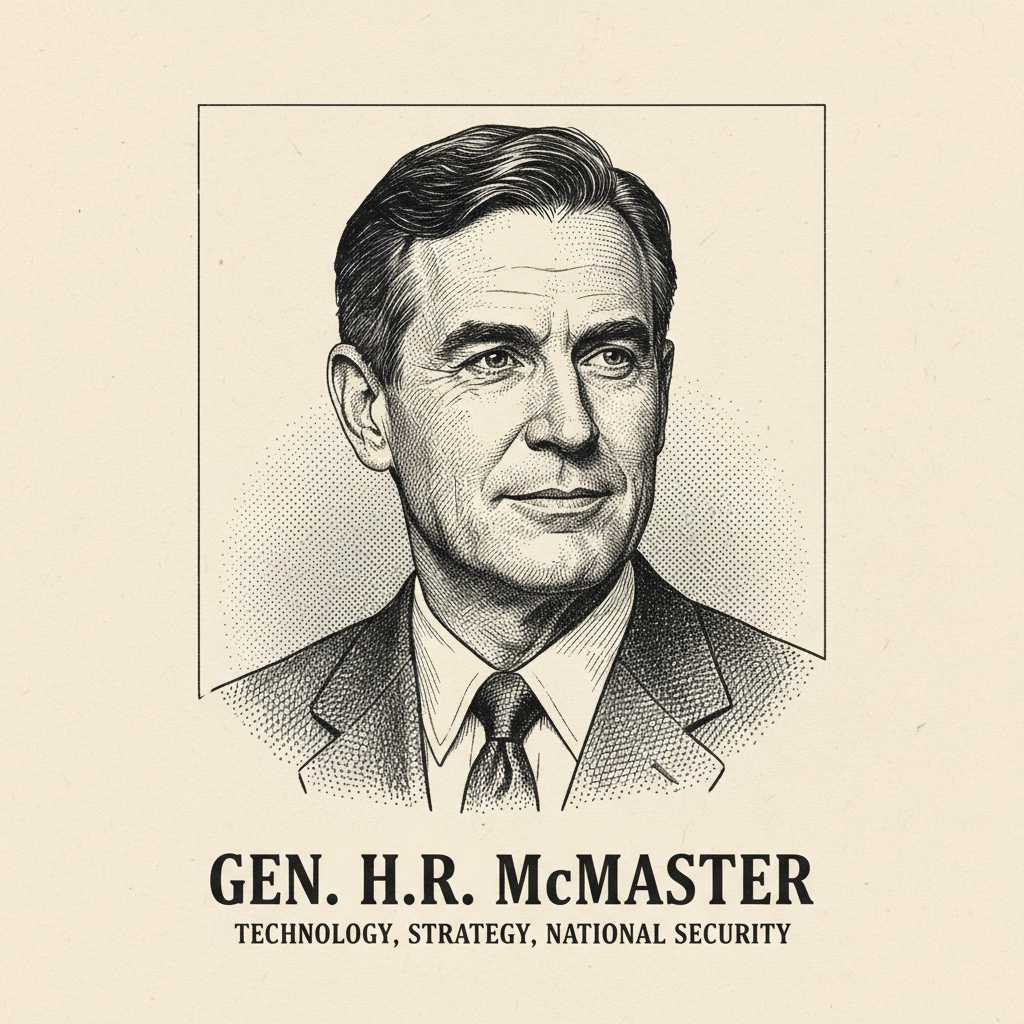
Gen. H.R. McMaster
A leading strategic thinker bridging military strategy, national security, and technology innovation.
H.R. McMaster is a retired United States Army Lieutenant General, renowned for his strategic intellect and battlefield leadership. He served as the 26th U.S. National Security Advisor from 2017 to 2018 under President Donald Trump. A decorated combat veteran, his career has spanned over three decades, marked by key roles in Afghanistan and Iraq. He is also a prominent author, notably for 'Dereliction of Duty', which critically analyzed the U.S. military's role in the Vietnam War, and 'Battlegrounds', examining contemporary global challenges. McMaster's expertise extends to military innovation, geopolitical risk, and the future of warfare.
Biography
Accomplishments
- 01Authored 'Dereliction of Duty' (1997), a seminal work critical of U.S. military leadership during Vietnam, influencing military reform efforts and strategic analysis.
- 02Led successful combat operations, notably the 2nd Armored Cavalry Regiment's decisive victory at the Battle of 73 Easting in 1991 and the stabilization efforts in Tal Afar, Iraq, in 2005, demonstrating innovative tactical leadership.
- 03Served as the 26th U.S. National Security Advisor (2017-2018), playing a central role in shaping U.S. foreign policy and national security strategy during a turbulent period.
- 04Pioneered military modernization efforts as Director of the Army Capabilities Integration Center, driving the integration of emerging technologies and future warfare concepts.
- 05Awarded the Silver Star, the Bronze Star with 'V' device, and the Purple Heart, among other decorations, for valor and service.
- 06Published 'Battlegrounds: The Fight to Defend the Free World' (2020), offering a comprehensive framework for understanding contemporary global threats and opportunities.
- 07Transitioned to influential roles in the private sector and academia, advising on defense technology and geopolitical strategy for companies like Velo3D and AE Industrial Partners, and at the Hoover Institution.
Lessons for Operators
Key Takeaways
Practical lessons distilled for operators, investors, C-levels, and capital allocators.
The Peril of Groupthink and 'Failing Upwards'
McMaster's analysis of Vietnam demonstrates how a lack of intellectual honesty and accountability at senior levels can lead to catastrophic outcomes. For organizations, actively combating groupthink through diverse viewpoints, robust dissent channels, and performance-based accountability is crucial to avoid strategic blunders and maintain long-term viability.
Innovation Driven by Necessity and Intellect
His career illustrates how strategic innovation emerges not just from technology, but from applying deep intellectual rigor to complex problems. Investing in critical thinking, historical analysis, and interdisciplinary research—alongside R&D—enables businesses to develop genuinely transformative solutions, exemplified by his work on military modernization.
Geopolitical Acuity as a Business Imperative
As National Security Advisor and a strategic advisor, McMaster emphasizes how global power dynamics, regional conflicts, and emerging technologies directly impact economic stability and market access. Business leaders must integrate geopolitical risk assessment into their strategic planning and supply chain management to anticipate disruptions and identify opportunities.
The Interconnectedness of Security and Prosperity
His work in Afghanistan and on national security policy highlights that stable, secure environments are prerequisites for economic development and sustained growth. Investors and fund managers should recognize that evaluating investment opportunities requires a comprehensive understanding of a region's governance, rule of law, and security landscape, beyond purely financial metrics.
Leadership Through Adversity and Complexity
McMaster's combat leadership and high-stakes advisory roles demonstrate the importance of calm decision-making under extreme pressure and the ability to navigate ambiguity. C-suite leaders and enterprise managers can learn to cultivate resilience, clarity of thought, and decisive action when facing market volatility, crises, or unforeseen challenges.
Technology's Dual-Use Nature and Ethical Considerations
His engagement with defense technology firms underscores that technological advancements, while offering competitive advantages, also carry significant ethical and societal implications. Leaders in tech-driven industries must consider the broader impact of their innovations, ensuring responsible development and deployment to maintain public trust and long-term viability.
The Power of Historical Context in Decision Making
Both 'Dereliction of Duty' and 'Battlegrounds' are steeped in historical analysis. This teaches that understanding past successes and failures provides invaluable context for current strategic choices. Leaders should encourage historical research and learning within their organizations to inform robust decision-making and avoid repeating past mistakes.
Frameworks & Principles
Named frameworks and strategic principles they popularized or embodied.
The 'Battlegrounds' Framework for Global Challenges
McMaster's framework from 'Battlegrounds' analyzes global challenges through the lens of revisionist powers (e.g., Russia, China), rogue regimes (e.g., North Korea, Iran), and transnational terrorist organizations. It emphasizes understanding their motivations, strategies, and the interconnectedness of these threats. He also details 'Competitive Blurring,' where adversaries integrate military, economic, and informational tools to undermine democracies.
When to useApplicable for C-level executives, investors, and strategists assessing geopolitical risks, market entry strategies, supply chain vulnerabilities, or long-term strategic planning in an interconnected global economy. Useful for understanding motivations of state and non-state actors impacting business environments.
Adaptive Military Innovation (AMI) / Future Warfare Concepts
Stemming from his roles at TRADOC and as a proponent of military modernization, this framework emphasizes continuous learning, rapid prototyping, and integrating emerging technologies (AI, robotics, cyber) with evolving operational concepts. It's about 'out-thinking' and 'out-innovating' adversaries by fostering agility and cross-domain synergy.
When to useIdeal for technology investors, R&D leaders, and enterprise strategists in fast-evolving industries. Useful for structuring innovation pipelines, fostering agility in product development, and understanding the strategic implications of disruptive technologies on market dynamics and competitive advantage.
Strategic Empathy and Understanding 'Human Terrain'
Derived from his experiences in counterinsurgency, this approach stresses the critical importance of deeply understanding the local population, cultural nuances, political structures, and socio-economic drivers in any operational environment. It moves beyond purely technical or military solutions to address root causes and win hearts and minds.
When to useHighly relevant for businesses entering new international markets, developing products for diverse customer segments, or managing complex stakeholder relations. Useful for market research, international business development, CSR initiatives, and building sustainable relationships with local communities.
Intellectual Candor and Accountability in Decision-Making
Informed by 'Dereliction of Duty,' this framework advocates for leadership cultures that demand rigorous, evidence-based analysis, encourage honest debate, and hold decision-makers accountable for outcomes. It opposes 'groupthink' and 'yes-men' by fostering an environment where challenging assumptions is valued.
When to useApplicable for any leadership team or board of directors seeking to improve strategic planning, risk management, and organizational effectiveness. Particularly useful during times of crisis, major investment decisions, or when evaluating significant strategic shifts, to ensure all perspectives are considered and biases are mitigated.
Recent Appearances
Latest interviews, keynotes, and press from the past half year.
 youtube.com
 youtube.com
 youtube.com
 youtube.com
 youtube.com
 youtube.com
 youtube.com
 youtube.com
 youtube.com
 youtube.com
 youtube.com
 youtube.com
 youtube.com
 youtube.com
 youtube.com
 youtube.com
 youtube.com
 youtube.com
 youtube.com
 youtube.com
 youtube.com
 youtube.com
 youtube.com
 youtube.com
 youtube.com
 youtube.com
Explore Related Titans
Other figures in the archive who share Gen. H.R. McMaster's domain, geography, or era.
More in Technology










From United States




Contemporaries — born 1960s