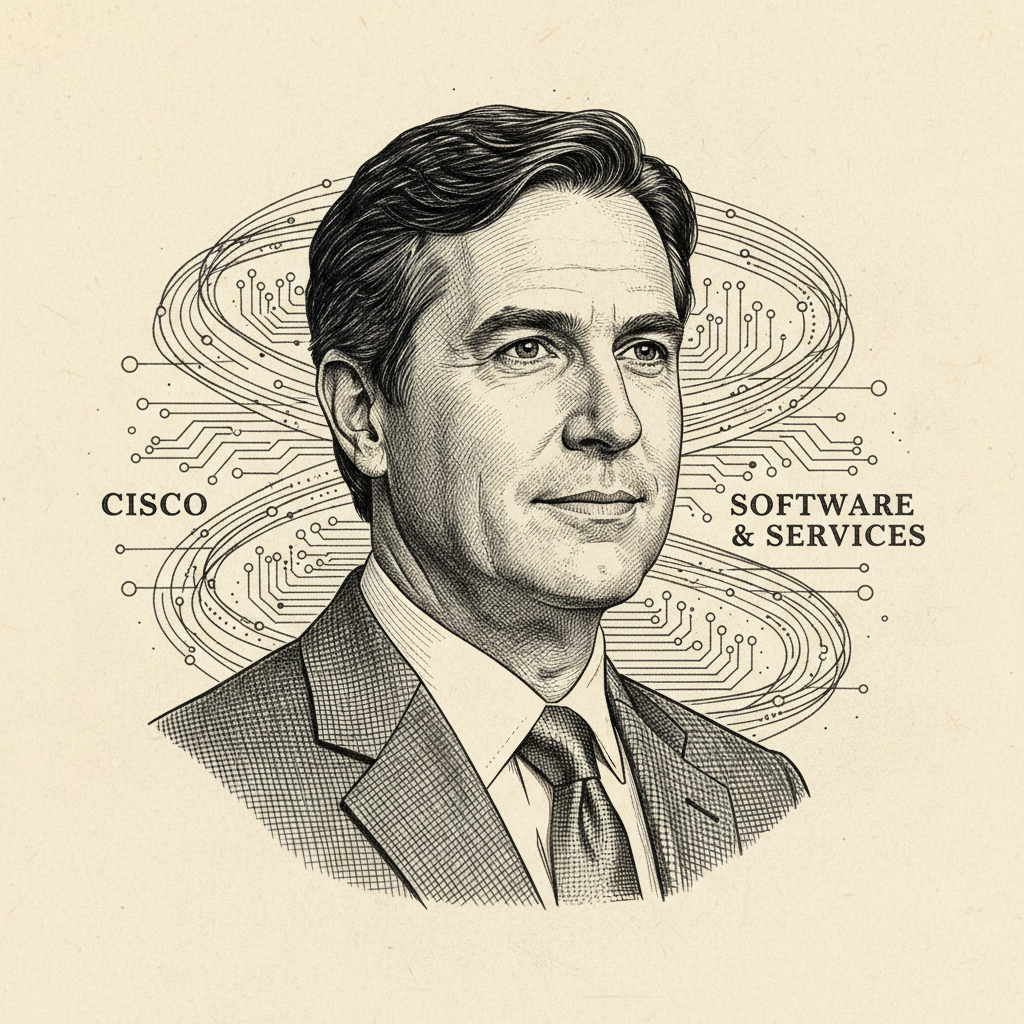
Chuck Robbins
Architect of Cisco's transformation into a software and services-centric enterprise.
Chuck Robbins is the Chairman and CEO of Cisco Systems, assuming the CEO role in July 2015. He has spearheaded Cisco's pivot from a hardware-dominant networking company to a software and services-led enterprise, emphasizing subscription-based revenue and cloud integration. His tenure is marked by strategic acquisitions and a focus on security, collaboration, and IoT.
Biography
Accomplishments
- 01Orchestrated Cisco's strategic pivot from a hardware-centric model to a software and subscription-led business, significantly increasing recurring revenue.
- 02Led major acquisitions including AppDynamics ($3.7 billion, 2017), Duo Security ($2.35 billion, 2018), and Splunk ($28 billion, 2023), enhancing Cisco's enterprise software and security portfolios.
- 03Successfully navigated Cisco through complex geopolitical challenges and supply chain disruptions, maintaining market leadership in core networking segments.
- 04Expanded Cisco's security and collaboration offerings (e.g., Webex enhancements), solidifying its position in critical enterprise software markets.
- 05Initiated and championed Cisco's Country Digital Acceleration (CDA) program, investing in national digital infrastructure and skills development globally.
Lessons for Operators
Key Takeaways
Practical lessons distilled for operators, investors, C-levels, and capital allocators.
Embrace Business Model Evolution
Incumbent leaders must be willing to fundamentally alter successful business models to adapt to market shifts. Cisco's transition from perpetual hardware licenses to software subscriptions under Robbins illustrates that even established giants must disrupt themselves.
Strategic M&A as a Growth Engine
Acquisitions, when aligned with a clear strategic vision (e.g., expanding into observability, security, application performance), can accelerate transformation and market presence. The Splunk acquisition is a prime example of a large, audacious move to reposition for data-driven insights.
Focus on Recurring Revenue
Prioritizing subscription and recurring revenue streams enhances financial stability, predictability, and valuation multiples. This shift provides a stronger foundation for sustained investment in R&D and market expansion.
Integrated Solutions Over Point Products
Enterprises increasingly seek holistic solutions. Robbins' strategy emphasizes integrating Cisco's diverse portfolio (networking, security, collaboration, observability) to deliver comprehensive platforms, reducing complexity for customers and increasing stickiness.
Frameworks & Principles
Named frameworks and strategic principles they popularized or embodied.
The 'Platform' Strategy
Building a comprehensive technology stack that integrates various products and services (networking, security, collaboration, observability, AI) into a unified offering, rather than selling disparate components. This aims to create a more sticky and valuable customer relationship.
When to useApplicable for technology companies with diverse product portfolios seeking to increase customer lifetime value, cross-selling opportunities, and competitive differentiation against niche players.
Subscription Economy Transition
Shifting from one-time product sales to recurring revenue models (subscriptions for software, services, and even hardware-as-a-service). This involves changes in sales, product development, and customer success.
When to useRelevant for any business looking to enhance revenue predictability, improve customer relationships, and unlock higher valuations. Particularly critical for traditional hardware or software license businesses facing commoditization.
Strategic Acquisition for Capability Expansion
Utilizing M&A to acquire new technological capabilities, market share, or talent that would be difficult or too slow to build organically. Acquisitions are aimed at filling strategic gaps and accelerating transformation.
When to useWhen a company needs to quickly enter new markets, acquire critical technology, or defend against competitive threats. Requires rigorous due diligence, integration planning, and a clear strategic rationale.
Recent Appearances
Latest interviews, keynotes, and press from the past half year.
 youtube.com
 youtube.com
 youtube.com
 youtube.com
 youtube.com
 youtube.com
 youtube.com
 youtube.com
 youtube.com
 youtube.com
 youtube.com
 youtube.com
 youtube.com
 youtube.com
 youtube.com
 youtube.com
 youtube.com
 youtube.com
 youtube.com
 youtube.com
 youtube.com
 youtube.com
 youtube.com
Sources & Further Reading
Profiles, interviews, podcasts, and articles used to compile and verify this entry. Each link opens at the original publisher.
Explore Related Titans
Other figures in the archive who share Chuck Robbins's domain, geography, or era.
More in Technology










From United States




Contemporaries — born 1960s