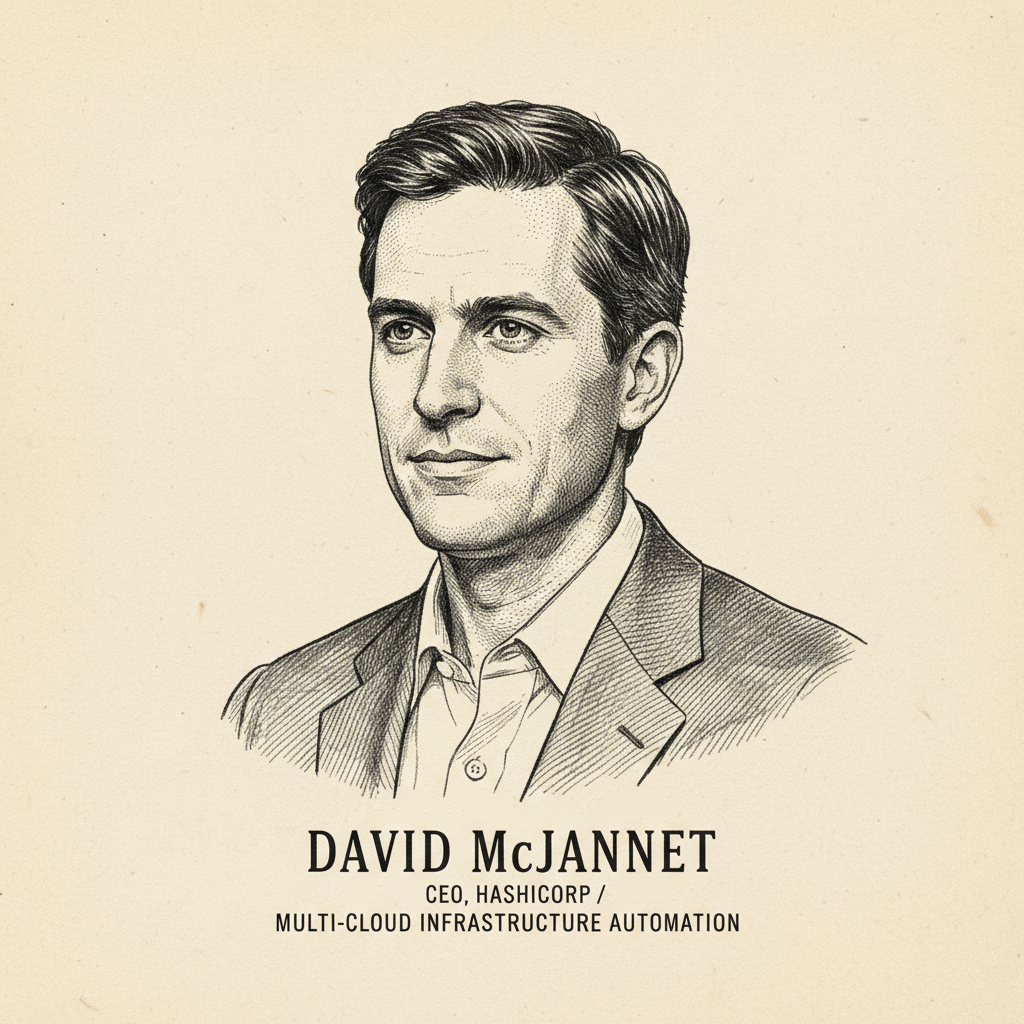
David McJannet
Architect of Open-Source Infrastructure Software Growth: David McJannet steered HashiCorp to an impactful IPO and through sustained product innovation.
David McJannet is the Chief Executive Officer of HashiCorp, a leading provider of multi-cloud infrastructure automation software. He has been instrumental in scaling the company from a startup to a publicly traded enterprise, specializing in open-source adoption, enterprise sales, and strategic product development, notably with tools like Terraform, Vault, and Consul.
Biography
Accomplishments
- 01Led HashiCorp from a privately held startup to a successful IPO on Nasdaq (HCP) in December 2021, achieving a valuation of approximately $14 billion.
- 02Orchestrated the commercialization strategy for core open-source projects like Terraform, Vault, and Consul, translating community adoption into enterprise revenue.
- 03Expanded HashiCorp's product portfolio and market reach, establishing the company as a foundational layer for multi-cloud and hybrid infrastructure automation.
- 04Grew HashiCorp's revenue from approximately $100 million in fiscal year 2020 to over $400 million in fiscal year 2023, reflecting strong market demand and execution.
- 05Successfully navigated the challenges of remote work and global expansion, maintaining high employee engagement and productivity during rapid growth periods.
Lessons for Operators
Key Takeaways
Practical lessons distilled for operators, investors, C-levels, and capital allocators.
Open Source as a Commercial Flywheel
McJannet's tenure at HashiCorp exemplifies how a strong open-source community provides a natural distribution channel and proven product validation, which can then be monetized through commercial enterprise versions offering additional features, support, and governance. This model reduces customer acquisition costs and builds strong loyalty.
Multi-Cloud Infrastructure Foundation
HashiCorp's success under McJannet is directly tied to identifying and solving the complex challenges of hybrid and multi-cloud environments. Products like Terraform and Vault became indispensable tools for companies seeking to manage infrastructure consistently across diverse cloud providers, establishing HashiCorp as a foundational layer in modern IT stacks.
Scaling Enterprise Software Sales
McJannet leveraged his experience at VMware to build a robust enterprise sales motion at HashiCorp. This involved structuring sales teams, developing partner ecosystems, and articulating clear ROI to large organizations, demonstrating how to effectively transition from a developer-centric adoption model to a top-down enterprise sales strategy.
Strategic IPO Execution
The meticulous preparation and execution of HashiCorp's IPO validated the market's appetite for critical infrastructure software. McJannet and his team successfully communicated the growth story and long-term potential of HashiCorp's offerings, securing substantial capital for future expansion and innovation.
Frameworks & Principles
Named frameworks and strategic principles they popularized or embodied.
Open-Core Commercialization Model
This framework involves offering a core set of features as open-source while reserving advanced capabilities, enterprise-grade support, and management tools for a commercial 'enterprise' version. This strategy drives adoption through the open-source community and monetizes through value-added commercial offerings.
When to useApplicable for software companies with strong community engagement looking to build a sustainable business model from widely adopted open-source projects.
Multi-Cloud Abstraction Strategy
Focus on developing software that provides a unified control plane or abstraction layer above diverse public and private cloud providers. This simplifies operations, ensures consistency, and provides vendor independence for enterprises.
When to useRelevant for companies targeting the enterprise market where multi-cloud adoption is prevalent, and operational complexity is a significant pain point.
Product-Led Growth (PLG) to Enterprise Sales Evolution
Start with a strong product that gains organic adoption (PLG), often through open-source or freemium models, and then build out a dedicated enterprise sales function to convert power users and expand into larger accounts with tailored solutions and support.
When to useIdeal for software companies whose products are inherently developer-friendly or have a strong initial bottom-up adoption, but also have significant upsell potential within large organizations.
Recent Appearances
Latest interviews, keynotes, and press from the past half year.

Explore Related Titans
Other figures in the archive who share David McJannet's domain, geography, or era.
More in Technology










From United States