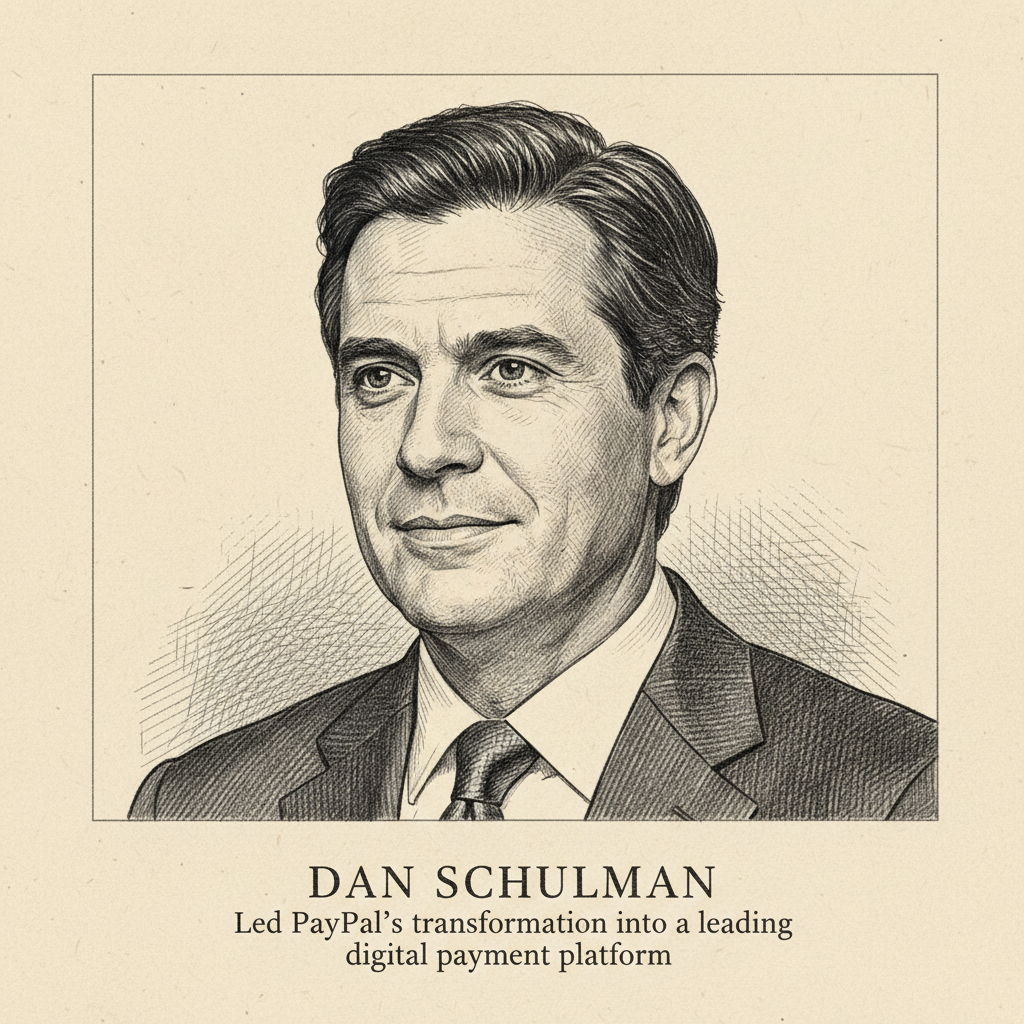
Dan Schulman
Transformative FinTech Leader & Digital Payments Pioneer
Daniel H. Schulman is an American business executive, recognized for his leadership in digitally transforming global payment systems. He served as the President and CEO of PayPal, previously held the role of Group President of Enterprise Growth at American Express, and was the founding CEO of Virgin Mobile USA. Schulman's career is marked by a consistent focus on expanding access to financial services and leveraging technology for consumer empowerment.
Biography
Accomplishments
- 01Led PayPal through its separation from eBay in 2015, establishing it as an independent public company and solidifying its position as a global leader in digital payments.
- 02Spearheaded American Express's global strategy for alternative mobile and online payment services, driving revenue diversification beyond traditional card products.
- 03Founded and scaled Virgin Mobile USA, demonstrating innovative approaches to prepaid mobile services and a focus on underserved consumer segments (1998-2007).
- 04Orchestrated significant growth at PayPal, resulting in a substantial increase in active accounts and total payment volume, further cementing its global market footprint.
- 05Championed financial inclusion initiatives, leveraging PayPal's platform to provide more accessible financial services to underbanked populations globally.
- 06Oversaw the acquisition of Honey Science Corporation by PayPal for approximately $4 billion in 2019, enhancing PayPal's commerce and rewards capabilities.
Lessons for Operators
Key Takeaways
Practical lessons distilled for operators, investors, C-levels, and capital allocators.
Mastering Corporate Separation
Schulman's successful execution of PayPal's split from eBay exemplifies how strong leadership, clear strategic direction, and operational excellence can transform a subsidiary into a standalone industry titan. This playbook is crucial for leaders considering significant corporate restructuring.
Innovation Beyond Core Products
From expanding American Express's mobile payments to diversifying PayPal's services, Schulman consistently pushed organizations beyond their traditional offerings. This teaches that sustained growth requires continuous innovation and aggressive pursuit of new revenue streams, even for established brands.
Strategic Acquisition for Ecosystem Expansion
The acquisition of Honey by PayPal, valued at $4 billion, showcases how targeted M&A can rapidly enhance consumer engagement and broaden an ecosystem. Operators should identify strategically complementary assets that accelerate growth and strengthen market position.
Empowering Underserved Markets
Schulman's commitment to financial inclusion at PayPal demonstrates that addressing the needs of the 'new majority'—those historically underserved by traditional financial institutions—is a powerful driver of both social impact and scalable business expansion. This approach attracts a broader customer base and fosters loyalty.
Frameworks & Principles
Named frameworks and strategic principles they popularized or embodied.
Ecosystem Expansion via M&A
A strategic framework focusing on augmenting a company's core platform by acquiring complementary technologies, customer bases, or service offerings to create a more comprehensive and sticky ecosystem.
When to useWhen seeking to rapidly diversify product lines, enter new market segments, or enhance customer value propositions beyond organic development capabilities, exemplified by PayPal's acquisition activities.
Spin-off for Value Maximization
A corporate strategy involving the separation of a business unit into an independent entity, typically to unlock hidden value, allow for distinct strategic focus, and improve resource allocation for both the parent and the new company.
When to useApplicable when a subsidiary's strategic goals diverge significantly from the parent company's, or when market analysts are undervaluing the sum of the parts; lessons from eBay/PayPal split are instructive here.
Financial Inclusion Business Model
Developing products and services specifically designed to address the needs of underbanked or underserved populations, often leveraging technology to reduce costs and increase accessibility.
When to useRelevant for companies in financial services, technology, or retail looking to tap into large, overlooked market segments while simultaneously fulfilling a social mission.
Sources & Further Reading
Profiles, interviews, podcasts, and articles used to compile and verify this entry. Each link opens at the original publisher.
Explore Related Titans
Other figures in the archive who share Dan Schulman's domain, geography, or era.
More in Technology









From United States