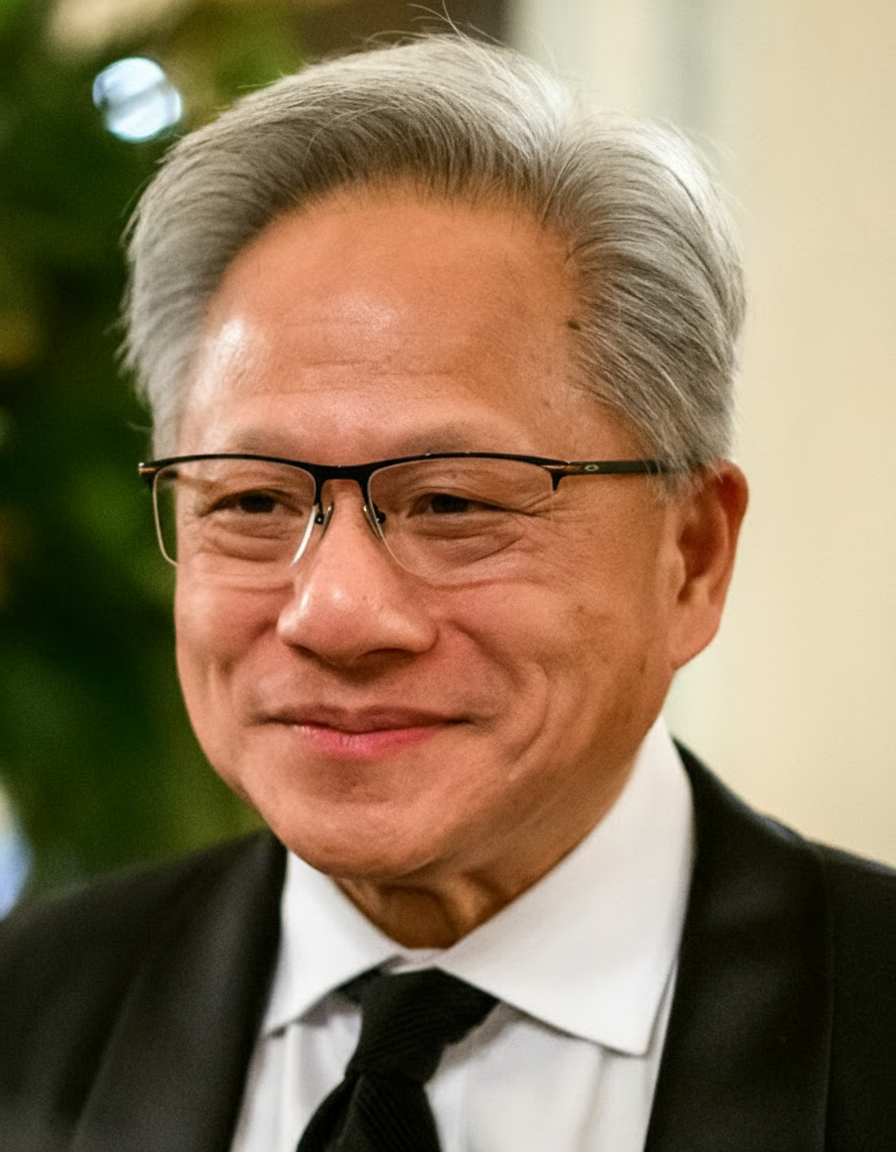
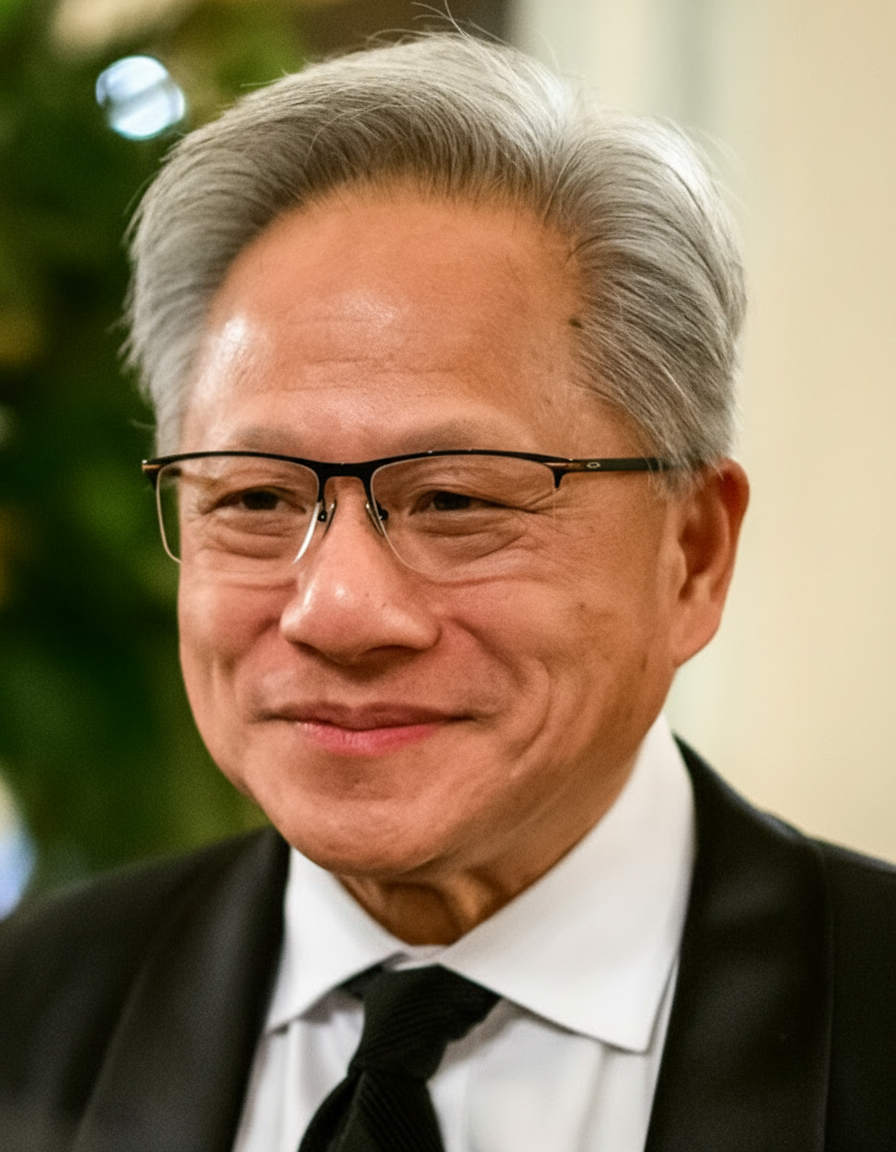
Jen-Hsun Huang
Co-founder, CEO, and President of NVIDIA, a global leader in accelerated computing and AI.
Jen-Hsun 'Jensen' Huang is the co-founder, president, and CEO of NVIDIA, established in 1993. Under his leadership, NVIDIA pivoted from primarily PC graphics chips to becoming a dominant force in accelerated computing, artificial intelligence, and data center technologies, revolutionizing several industries through its GPU technology.
Biography
Accomplishments
- 01Co-founded NVIDIA in 1993 and led its initial public offering in 1999, establishing a dominant position in PC graphics processing.
- 02Pioneered the development and commercialization of the Graphics Processing Unit (GPU) with the GeForce 256 in 1999, fundamentally changing computer graphics.
- 03Orchestrated NVIDIA's strategic pivot to general-purpose computing with the CUDA platform in 2006, opening GPUs to scientific computing and later, AI.
- 04Positioned NVIDIA as the leading hardware provider for artificial intelligence and deep learning, making its GPUs indispensable for research and deployment.
- 05Expanded NVIDIA's market capitalization to over a trillion dollars, driven by its critical role in the data center and AI infrastructure buildout.
- 06Spearheaded NVIDIA's diversification into new markets including autonomous vehicles (NVIDIA DRIVE), professional visualization, and enterprise software platforms.
Lessons for Operators
Key Takeaways
Practical lessons distilled for operators, investors, C-levels, and capital allocators.
Long-Term Vision over Short-Term Gains
Huang's commitment to developing CUDA and investing in AI infrastructure long before it was profitable showcases the power of a sustained, long-term strategic outlook. Companies should allocate resources to initiatives that may not yield immediate returns but promise significant future market leadership.
Strategic Resilience and Adaptability
NVIDIA's survival and subsequent dominance, stemming from early failures and an ability to 'pivot' strategically, highlights the critical importance of organizational resilience. Leaders must be prepared to make bold changes and learn from setbacks, as Huang noted, his company's survival depended on it.
Ecosystem and Partnership Leverage
Huang's recognition of TSMC's importance underscores the value of critical supply chain partners. Building strong, mutually beneficial relationships with key players in your ecosystem can provide competitive advantages and ensure operational continuity, especially in complex manufacturing or service industries.
The Power of Enabling Technology
NVIDIA didn't just build faster chips; it built an entire ecosystem (CUDA) that enabled others to innovate in AI. Focus on creating foundational platforms or tools that empower an entire industry to scale, rather than just developing end products, can create exponential growth opportunities.
Proactive Engagement with Societal Impact
Huang's public discussions about the ethical dimensions and potential risks of AI ('AI Hackers Are Coming Dangerously Close to Beating Humans') demonstrate leadership beyond quarterly earnings. For high-impact technologies, proactive engagement with ethical considerations builds trust and prepares organizations for future regulatory or societal challenges.
Frameworks & Principles
Named frameworks and strategic principles they popularized or embodied.
Ecosystem Strategy (Huang's NVIDIA)
Focuses on building an interconnected network of technologies, partners, and user communities around a core product or platform (e.g., NVIDIA's GPU + CUDA). The goal is to create network effects that enhance the value of the core offering and make the ecosystem difficult to displace.
When to useWhen developing a foundational technology with broad applications; when market leadership requires cultivating developer communities and strategic alliances; when seeking to establish a defacto industry standard.
Vision-Driven R&D Investment
A strategy where a significant portion of R&D is directed towards long-term, high-risk projects based on a clear, often contrarian, vision of future market needs, rather than immediate profitability or existing market demands. This involves patience and sustained investment over many years.
When to useWhen operating in rapidly evolving tech sectors; when a company has the capital to invest in speculative but transformative technologies; when aiming to create entirely new markets or disrupt existing ones with breakthrough innovations.
Platform Enablement Model
Instead of just selling products, a company provides the underlying tools, infrastructure, or platform that empowers others to build new applications and services. This multiplies the company's impact and expands its market reach indirectly.
When to useWhen the core technology has general-purpose applications; when aiming to foster a large developer ecosystem; when the market for direct applications might be niche, but the market for enabled applications is vast (e.g., selling picks and shovels during a gold rush).
Recent Appearances
Latest interviews, keynotes, and press from the past half year.
 youtube.com
 youtube.com
 youtube.com
 youtube.com
 youtube.com
 youtube.com
 youtube.com
 youtube.com
Sources & Further Reading
Profiles, interviews, podcasts, and articles used to compile and verify this entry. Each link opens at the original publisher.
- podcastNVIDIA CEO Jensen Huang credits the company's survival to a ...facebook.com→
- podcastJensen Huang said getting Nvidia off the ground came with some ...facebook.com→
- podcastJensen Huang's Advice in 25 Minutes | How to Take Risks and Still ...youtube.com→
- podcastElon Musk LEAVES NVIDIA CEO Jensen Huang Speechless After ...youtube.com→
- podcastElon Musk LEAVES NVIDIA CEO Jensen Huang Stunned ... - YouTubeyoutube.com→
- podcastJensen Huang on Why TSMC Is So Important - YouTubeyoutube.com→
- podcastWhy Waiting for Clarity Slows You Down | Nils Ehrenfried - YouTubeyoutube.com→
- podcastStrange Loop Podcast | Podcast on Spotifyopen.spotify.com→
- podcast3.8_Side-hassle - YouTubeyoutube.com→
- podcastNorthern California-based Luma AI, whose backers include Nvidia ...facebook.com→
- podcastWeekend Tech Recap with The Tech prophet - Facebookfacebook.com→
- podcast最近All-In Podcast 一段影片被瘋傳Chamath 直接在Jensen Huang ...threads.com→
- podcastJensen Huang Predicts Future of Local Nuclear Reactors | TikToktiktok.com→
- podcastAI Power Index 2025: 100 Most Influential Leaders in A.I. - Observerobserver.com→
- podcastNvidia-backed AI startup wants to solve AI's 'hard problem' - Facebookfacebook.com→
- podcastRazer, founded and run by Min-Liang Tan for two decades, is ...facebook.com→
- podcastJensen Huang Predicted the AI Revolution in 2010 | TikToktiktok.com→
- podcastStarting Nvidia all over again? Jensen Huang says no chance. https ...facebook.com→
- podcastNvidia-backed AI startup wants to solve AI's 'hard problem' - Facebookfacebook.com→
- podcastThe Nvidia CEO said running the semiconductor company required ...facebook.com→
- podcastStarting Nvidia all over again? Jensen Huang says no chance. https ...facebook.com→
- podcastTHE “NEVER QUIT THE KITCHEN TABLE PRINCIPLE” How ...facebook.com→
- podcastBooks from Lex Fridman Podcast #494 - Jensen Huang | LexLiblexlib.io→
- podcastHere's my conversation with Jensen Huang, CEO of NVIDIA, the ...facebook.com→
- podcastJensen Huang is the founder, president, and CEO of @nvidia the ...instagram.com→
- podcastWe were wondering why the coffee booth was so crowded ...facebook.com→
- podcastJensen Huang backstage at #DellTechWorld, ready to talk the future ...instagram.com→
- podcastThe real story behind NVIDIA CEO Jensen Huang is not ... - Facebookfacebook.com→
- podcastJensen Huang makes AI agents click with one absurd image: a robot ...instagram.com→
- podcastBrb crying seeing Jensen Huang @nvidia wasn't on my bingo card ...instagram.com→
- podcastJensen Huang turns 63 today! Born in 1963, NVIDIA CEO ...instagram.com→
- podcastWhen Jensen Huang signs your XE7745 server and gives a ...instagram.com→
- podcastJensen Huang adalah sosok di balik kesuksesan Nvidia yang kini ...instagram.com→
- podcastThrow back to last month's surprise catch up with @nvidia CEO ...instagram.com→
- podcastJensen Huang works every day, starting at 5 AM and ending by 9:30 ...instagram.com→
- podcastTaiwan tech day showcases lab to market technologies - Facebookfacebook.com→
- podcastWhen Jensen Huang says every single pixel is ray traced, he's not ...instagram.com→
- podcastJapan should pursue an AI strategy that blends domestic innovation ...facebook.com→
- podcasttech 45' - Audiomeanspodcasts.audiomeans.fr→
- podcast$46B of hard truths: Why founders fail and why you need ... - YouTubeyoutube.com→
- podcast"Anh ấy có 225 triệu đô trong ngân hàng — nhưng ... - Instagraminstagram.com→
- podcastGeoffrey Hinton - Wikipédiafr.wikipedia.org→
- podcastLa paradoja del oro: por qué el metal refugio cae cuando más lo ...elprofesordeciencias.wordpress.com→
- podcastNvidia CEO Jensen Huang reveals the strategy that gives ... - TikToktiktok.com→
Explore Related Titans
Other figures in the archive who share Jen-Hsun Huang's domain, geography, or era.
More in Technology


Contemporaries — born 1960s